Air purifiers for bedrooms and children's rooms
Air purifier bedroom basics: size by floor area, read night noise figures, avoid ozone in children's rooms, and know what no agency says about nurseries.
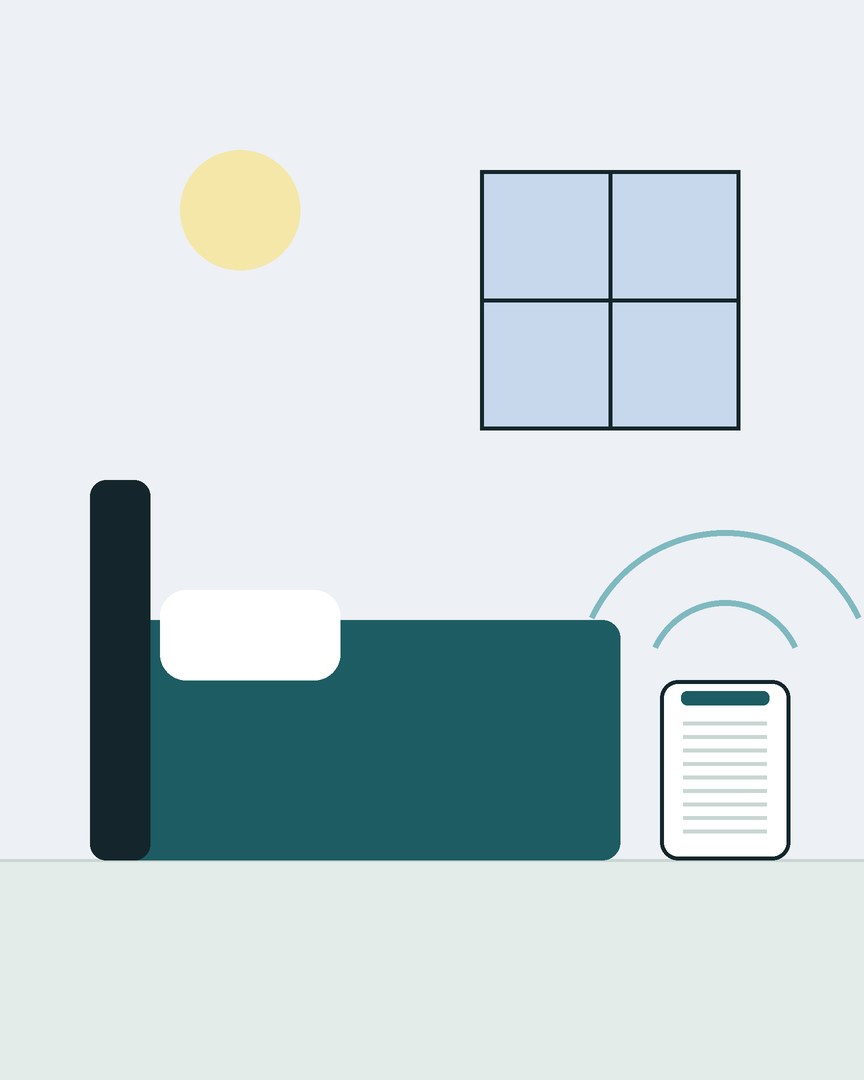
An air purifier in the bedroom is sized like any other, with one difference that decides whether it stays switched on: it has to run in a quiet room while someone tries to sleep. Size it by floor area, check how much clean air it delivers at the speed you can tolerate at night, keep it filter-only, and give it open space. For a child’s room or nursery, the honest position is narrower still. Among the EPA, CDC, AHAM and pediatric documents reviewed for this page, none issues a recommendation for or against a purifier in a nursery apart from wildfire-smoke advice covered below, so any claim that one is required, or that one is safe, goes further than those agencies have. Nothing here is medical advice; a pediatrician or clinician is the right person for questions about a specific child or condition.
Size it for the room, then for the night setting
Start with the floor area. The usual rule of thumb, from AHAM and EPA’s wildfire guidance, is a smoke CADR of at least two-thirds of the floor area in square feet, and EPA’s air cleaner guide charts 130 cfm for 200 square feet and 195 cfm for 300 square feet.
- Measure the room. A 12 by 14 foot bedroom is 168 square feet.
- Multiply by two-thirds: 168 x 2/3 = 112 cfm of smoke CADR.
- Add margin for a ceiling above 8 feet. EPA says “If you have high ceilings (above 8 feet), you should consider using an air cleaner that is sized for a larger area.”
- Then ask what the unit delivers at the speed you will actually run overnight.
Step 4 is where a rating and a bedroom part ways. EPA says “the rating is typically measured at the air cleaner’s highest speed” and that “an air cleaner will filter less air if it is set at a lower speed.” EPA’s Technical Summary adds that at lower settings “the CADR may not be known,” and could be “considerably lower than the highest advertised.” In one home test by Chen et al. (2022), the medium setting’s estimated CADR was roughly three times the low setting’s. In a randomized crossover by Lu et al. (2024), the researchers chose a quieter mode with a measured CADR of 263 cfm, against an advertised 330 cfm at the top setting, because they wanted people to keep it running.
A practical conclusion: buy a unit rated well above the room’s minimum, so its quiet setting still moves a useful amount of air.
Noise at night: what the numbers mean
A CADR rating says nothing about how a unit sounds in a bedroom. EPA’s Technical Summary says “as of 2017, quantified operating noise is not a factor in the performance ratings of portable air cleaner ratings in the United States.”
The reference points that do exist come from other contexts:
| Reference | Figure | What it is |
|---|---|---|
| WHO Europe noise fact sheet | Less than 30 dB(A) in bedrooms at night | Community noise guideline “for a sleep of good quality” |
| EPA air cleaner guide | Around 50 dB | “roughly the operating noise of a modern refrigerator” |
| Chen et al. (2022) | About 31.4 dB low, about 56.5 dB high | One home test, as reported by the authors; not a rating |
| Lu et al. (2024) | 59.6 +/- 11.0 dB, about 13.7 dB over background, measured at 1 meter on the quieter mode | One trial’s chosen setting, read with a NIOSH sound-meter app |
Treat the WHO figure as a guideline for environmental noise rather than a spec for a purifier, and note that the Lu measurement was taken at a distance and setting that may not match your room. The gap between 30 dB(A) and the higher measurements is at least consistent with what EPA records: “One study specifically noted that occupants reported excessive noise as the reason for turning off air cleaners at night (Sulser et al. 2009).” A unit that gets switched off filters nothing. The noise guide covers how to compare units and the settings to look for.
Doors, windows and what a bedroom unit can reach
Keeping a bedroom door closed makes the purifier’s work easier, because the unit is cleaning one room instead of feeding the hallway. EPA’s wildfire guidance says “to maximize effectiveness, use the air cleaner in a room with doors and windows closed, when it is safe to do so,” and its Technical Summary says a portable air cleaner “will be much more effective for a specific room when any exterior doors and windows in a room are closed.” Lu et al. found larger PM2.5 reductions in the room with the unit (78.8%) than in a second room (57.9%), and lower reductions at night than during the day: 73.3% against 80.0% in the primary room.
A closed room has less fresh air, however, and a filter does not address that. There is a real trade-off for a sleeping room with a shut door, and a purifier does not replace ventilation. EPA’s position is that filtration supplements source control and ventilation. Open a window when outdoor air is clean and the night is mild, and close it when the air outside is the thing you are trying to keep out.
Children’s rooms and nurseries
Three parts of the record deserve a plain statement.
Ozone. This is the clearest instruction in the sources. A factsheet from the Pediatric Environmental Health Specialty Units on wildfire smoke says “Never use an ozone-generating air cleaner.” EPA says to avoid units that intentionally produce ozone, calling it a lung irritant, and CARB names children among the groups “especially vulnerable to health problems from breathing ozone.” The page on ozone generators covers why. EPA also notes that electrostatic precipitators, ionizers, UV lights without adequate lamp coatings and plasma air cleaners “may have the potential to emit ozone.” A filter-only unit avoids that entire category.
CARB certification. California’s section 94802(a) says that no person shall manufacture for use in California, or sell, an indoor air cleaning device “unless the device is certified by CARB to produce an ozone emission concentration not exceeding 0.050 ppm.” CARB’s list page says certification covers electrical safety and ozone, and that it “does not reflect air cleaner effectiveness or ‘health safety’.” The same page adds that certification “does not imply that a specific air cleaner is ‘safe to use’.” It speaks to ozone and electrical safety and to nothing else.
Evidence in children. The record is thin. The BREATHE trial protocol (Cowan et al., 2024) states that no clinical trial has tested whether HEPA filtration units increase symptom-free days in infants hospitalized for bronchiolitis, and that protocol reports no results. It told parents not to use the maximum setting and not to place the unit within 5 feet of where the child sleeps, and it listed possible risks including false reassurance about home air quality, noise, and injury or electrical shock during installation, which it says requires childproofing. Those were conditions for one study, not general guidance, but the list of risks is worth reading. In children aged 10 to 16, James et al. (2020) ran a bedroom HEPA unit against a dummy unit for one month each and found no significant or clinically meaningful change in asthma control across the whole group of 42 children analyzed; in the subgroup with poorly controlled asthma, scores fell with both units and the difference between them was not significant.
If wildfire smoke is the reason for considering a unit in a child’s room, the agencies are more specific: EPA advises a clean room with a unit that does not produce ozone, and PEHSU’s factsheet tells parents to create a clean room and buy a portable air cleaner for it. On respirators the sources differ. PEHSU’s 2020 factsheet says even N95 masks are not made to fit children, while EPA’s June 2026 guide says NIOSH does not currently approve respirators for children and that well-fitting N95s are less likely for ages 2 to 7, and NIOSH’s 2025 bulletin says masks and respirators should not be worn by children younger than 2, so check current advice with a pediatrician.
Placement in a bedroom
EPA says “keep air cleaners away from curtains and anything that might block airflow” and that the unit “should not be situated where walls, furniture, curtains, and other obstructions will block the intake and outlet.” Beyond that, the following are common sense rather than findings:
- Put the unit on a stable floor surface where it cannot be tipped by a child or a pet.
- Keep the cord out of reach and out of walkways, and do not run it under a rug.
- Keep a nursery unit out of reach of the crib.
- Turn off bright indicator lights, or choose a unit that dims them.
The wider logic of positioning is in the guide on where to put an air purifier.
Running it and judging it
Running a purifier through the night makes sense if the point is cleaner air during those hours. EPA says “the longer the air cleaner runs, the more air it filters.” In practice, the setting you will keep on is the setting that matters, and results for sleeping-area filtration are mixed: Sublett’s 2011 review calls sleep breathing-zone filtration, which delivers filtered air to the sleeper rather than running an ordinary bedside unit, effective in three small trials (14 to 35 patients), with one showing no change in lung function despite better quality of life and another finding daytime symptoms did not improve. Keep the filter fresh on the maker’s schedule, because EPA says that “if a filter is dirty and overloaded, it won’t work well.” A purifier is a household appliance that cleans air; what it does for sleep or health has not been established by the sources above.
Common questions
Is it OK to sleep with an air purifier on?
Nothing in the agency sources says to avoid it, and EPA says the longer a unit runs the more air it filters. The practical limit is noise: one study found people turned units off at night because of it. A filter-only unit avoids the ozone question. Anyone with a health condition should ask a clinician.
Should an air purifier be close to the bed?
Close enough to serve the room but with clear space around it. EPA says to keep it away from curtains and anything that blocks airflow. A research protocol on infants told parents not to place the unit within 5 feet of where the child sleeps, which is one study's instruction and not a general rule.
Does an air purifier dry out the air in a bedroom?
A filter unit moves air through a filter and does not remove water from it, so it should not change the humidity reading in any meaningful way. If a bedroom feels dry, check the humidity with a meter. EPA says not to humidify above 50 percent relative humidity.
Do I need a purifier in my baby's room?
No agency document read for this page says so. A published trial protocol states that no clinical trial has tested HEPA filtration for symptom-free days in infants hospitalized for bronchiolitis, and that protocol reports no results. Ask your pediatrician if a specific concern, such as smoke, is the reason you are considering one.
What does CARB certified mean for a bedroom purifier?
It relates to ozone emissions and electrical safety, with a limit of not exceeding 0.050 ppm. CARB's list page says certification does not reflect air cleaner effectiveness or health safety, so it answers one question and leaves the rest open. Filter-only units are listed as mechanical.
Sources
Read next
Where to put an air purifier, and how little is proven
Where to put an air purifier: the room you use most, clear intake and outlet, doors closed. What agencies actually say, and what has never been formally tested.
Air purifier vs humidifier vs dehumidifier: three jobs
Air purifier vs humidifier vs dehumidifier: one filters particles, one adds moisture, one removes it. Which fits which complaint, with EPA's humidity limits.
How to choose an air purifier: a step-by-step decision
How to choose an air purifier: name the problem, size CADR to the room, check the filter, noise at your real setting and ozone, and know when not to buy.
Do air purifiers work? What the evidence shows
Do air purifiers work? They measurably cut airborne particles in a room. Health results are smaller and mixed. What trials measured, found and did not show.
How do air purifiers work? Fan, filter and repeated passes
How do air purifiers work? A fan pulls room air through a filter and returns it, again and again. What each method removes, and what an air purifier cannot do.