How do air purifiers work? Fan, filter and repeated passes
How do air purifiers work? A fan pulls room air through a filter and returns it, again and again. What each method removes, and what an air purifier cannot do.
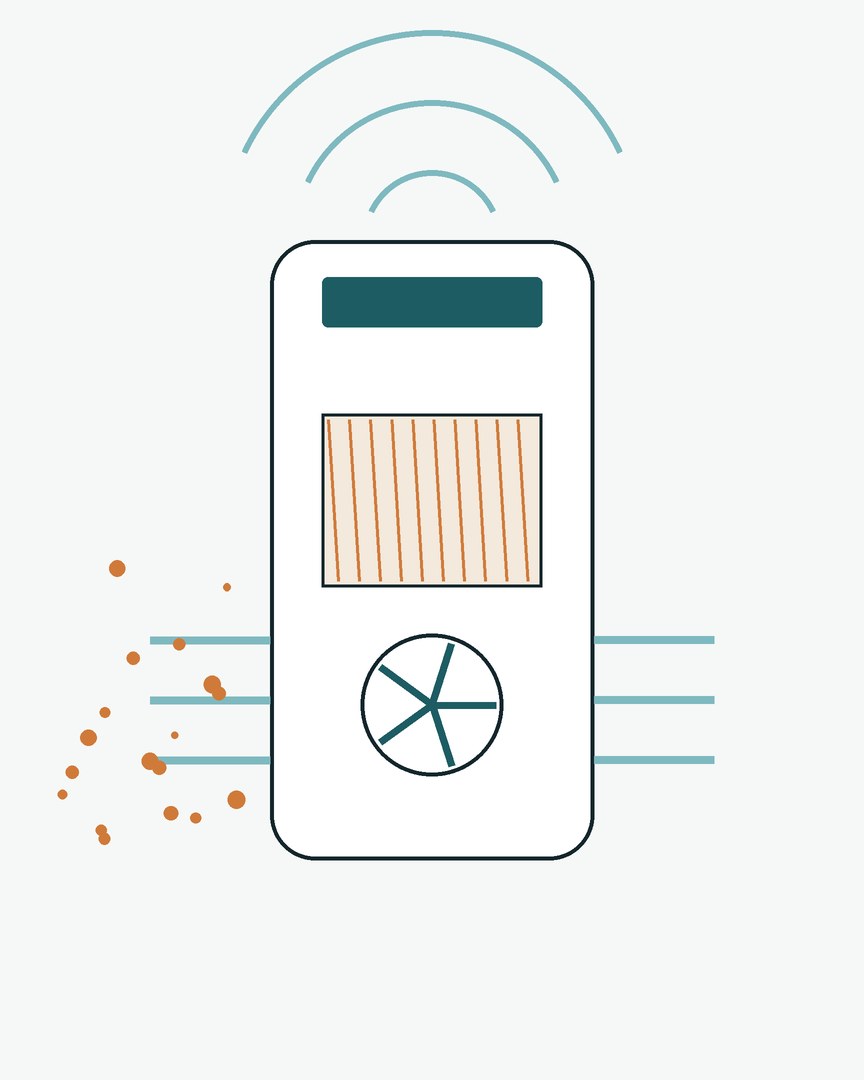
How do air purifiers work? A fan pulls air from the room through one or more filters and blows it back out, and the room gets cleaner only because the same air goes through that loop many times. Each pass takes out some of what the air was carrying. An air purifier with a fibrous filter removes particles such as smoke and fine dust; it needs a separate sorbent, usually activated carbon, to do anything about gases. Three things decide the result: how good the filter is, how much air the fan moves through it, and how many hours the machine actually runs. EPA calls these machines portable air cleaners and says they are designed to filter the air in a single room or area, so everything below applies to one room at a time.
The loop inside the machine
Most units share these parts, though the layout varies by model.
- An intake, often a grille on the front, back or sides.
- A coarse prefilter, which stops hair and lint before they reach the main filter.
- The main particle filter, usually pleated.
- On some models, a layer of activated carbon or another sorbent for gases.
- A fan, and an outlet that sends the air back into the room.
Where a unit has both kinds of filter, EPA’s Technical Summary says gas-phase filters containing sorbents should generally be located downstream of particle air filters.
The cleaned air then mixes with the rest of the room, and mixed air comes back round to the intake. A purifier therefore thins out the pollution in a room instead of removing it once and for all, and new particles keep arriving from cooking, candles, people moving around and air leaking in from outdoors. EPA’s practical point follows: the longer the air cleaner runs, the more air it filters.
Here is what the loop means in cubic feet. A 10 by 12 foot room with an 8-foot ceiling holds 960 cubic feet of air. A unit delivering 200 cubic feet per minute of clean air moves a volume equal to that room in a little under five minutes. That does not mean the room is clean after five minutes: part of what the fan draws in has already been filtered, and part of the dirty air is still sitting in the far corner.
How a filter catches a particle
A pleated filter is not a sieve with holes smaller than the particles. It is a thick mat of fibers, and particles get caught in a few different ways as the air threads through it.
- Large particles are too heavy to follow the air around a fiber, so they run straight into it.
- Middle-sized particles follow the air but pass close enough to touch a fiber, and they stick.
- The smallest particles are knocked about by air molecules and wander sideways until they hit a fiber.
This is why the size that gets through most easily is in the middle. EPA says the 0.3 micron figure in the HEPA definition corresponds to the worst case, the most penetrating particle size, and that particles larger or smaller are trapped with even higher efficiency. EPA, using the definition set by the Department of Energy, says such a filter can theoretically remove at least 99.97% of airborne particles of that size.
That number describes a filter meeting a definition, and it does not describe a machine in a room. EPA’s Technical Summary says there is no widely accepted definition of HEPA performance in consumer products, and that filters sold as HEPA for homes are unlikely to match those used in health care and industry, though they still usually reach 99% or higher for the particle sizes tested. A gap around the edge of the filter also lets some air bypass it. The guide to HEPA filters covers the labels in detail.
Airflow matters as much as the filter
A perfect filter in a machine that moves little air cleans little air. The rating that combines the two is the clean air delivery rate, or CADR, which EPA describes as a measure of the delivery of relatively clean air, expressed in cubic feet per minute. A unit with a slightly less efficient filter and a much stronger fan can deliver more clean air than one with the reverse.
Two limits apply to the number on the box. EPA says the rating is typically measured at the air cleaner’s highest speed and that the unit will filter less air at a lower speed. EPA also says the CADR system is for particles only. In one home test, Chen and colleagues reported in 2022 that the medium setting moved about three times the air of the low setting, a gap worth remembering if the machine spends its life on low. How CADR ratings work explains the three scores and how to use them.
Four ways of cleaning air, and what each one acts on
| Method | How it works | Acts on | What EPA cautions |
|---|---|---|---|
| Fibrous filter, including HEPA | Traps particles on fibers | Particles only | Must be replaced; a clogged filter cuts airflow |
| Activated carbon and other sorbents | Gases stick to or react with the material | Some gases and odors | Limited capacity; thin layers saturate quickly |
| Electrostatic precipitator | Charges particles and collects them on plates | Particles only | May produce ozone; efficiency falls as plates load |
| Ionizer | Charges particles so they stick to room surfaces | Particles, which stay in the room | May produce ozone; particles can be stirred back up |
Sorbents for gases
Gases are single molecules and pass straight through a particle filter. EPA says only adsorbent and chemisorbent media have been shown to be effective gas-phase air cleaners for some gaseous pollutants without producing potentially harmful byproducts, and that not all gases are removed equally. Activated carbon has the potential to remove most hydrocarbons, but EPA says it is not especially effective against formaldehyde, ammonia or nitrogen oxide, and that carbon monoxide is not readily captured by sorbents. The amount of material decides how long it lasts: EPA says thin layers can become quickly saturated, and the filter can then give previously captured pollutants back to the room. More on that in the guide to activated carbon filters.
Electronic methods
Electrostatic precipitators (ESPs) and ionizers use high voltage to charge particles. They do not remove gases or odors, and EPA says they may produce ozone, either as a byproduct or by design. An ionizer usually has no fan, so EPA says it typically has very low CADRs, and the particles it charges land on walls and curtains, where walking or vacuuming can put them back in the air.
UV lamps and photocatalytic units fall in a separate group. EPA says typical home UV units do not deliver a sufficient dose because the air passes too quickly or the light is too weak, and UV captures no particles. It reports that photocatalytic cleaners have been shown to generate formaldehyde, acetaldehyde, nitrogen dioxide and carbon monoxide. Ozone generators are a third case: EPA says they should not be used in occupied spaces and that no federal agency has approved them for that use.
What removes neither particles nor gases
Some features sold alongside the filter do no cleaning of their own. A sensor reports on the air and controls the fan, and a display or an app adds nothing to the air passing through. A fragrance adds a chemical to the room. Check that a unit’s main claims rest on a filter with a published rating, and treat every other feature as convenience.
What that means for dust, smoke and pet dander
Smoke is the easiest case, because its particles are small and stay in the air long enough to reach the intake; CDC calls the smoke particles the smallest of the three CADR test particles. Household dust is harder. EPA’s Technical Summary says larger particles settle out of the air rapidly, so air filters are not likely to remove them effectively from a home.
Pet allergen sits in between. EPA says a significant fraction of cat and dog allergens are carried on small particles, which remain airborne longer and are more likely to be removed by air cleaners. EPA also reports that levels of allergens in air or in dust were reduced in only one out of three studies reviewed that measured them. All of that describes what is in the air and says nothing about symptoms. Anyone choosing a purifier because of a health condition should talk to a clinician.
What an air purifier does not do
EPA says portable air cleaners can reduce indoor air pollution but cannot remove all pollutants from the air. Specifically, a purifier:
- Provides no ventilation. It recirculates the room’s air and brings in nothing from outdoors.
- Does not control humidity. A filter neither adds nor removes water vapor, and EPA says air cleaners will not resolve a mold and moisture problem.
- Does nothing about settled dust. EPA notes that larger allergen-bearing particles settle out of the air rapidly, and effective control of them requires routine cleaning.
- Does not stop pollution at the source. EPA says the most effective ways to improve indoor air are to reduce or remove the sources and to ventilate with clean outdoor air, with filtration as a supplement.
Whether that adds up to a benefit you would notice is a separate question from how the machine works. The evidence on air measurements and on health is laid out in do air purifiers work.
What running one looks like in a real home
The clearest picture of the loop in ordinary use comes from a randomized cross-over trial by Lu and colleagues, published in 2024. In 29 homes, researchers ran the same unit with its HEPA filter installed and with it removed, across two consecutive 24-hour periods, and asked participants to leave it on. Mean PM2.5 fell 78.8% in the room with the unit and 57.9% in a second room. The trial measured particle concentrations in the air, over a short period, and did not measure anyone’s health.
Common questions
Do air purifiers bring in fresh air from outside?
No. A portable unit draws in the air already in the room and returns it, so the amount of outdoor air in the room does not change. Bringing in outdoor air is the job of an open window or a ventilation system. EPA treats filtration as a supplement to source control and ventilation rather than a replacement for either.
How do air purifiers work for dust?
They catch dust only while it is floating and only when the air carrying it reaches the filter. EPA's Technical Summary notes that larger particles settle onto surfaces rather rapidly, which is why air filters are not likely to remove them effectively from a home. Dust on shelves and floors stays there until someone cleans it.
Do air purifiers work across rooms?
Mostly they clean the room they are in. EPA describes portable air cleaners as designed to filter a single room or area. In a 2024 trial by Lu and colleagues, particle levels fell in a second room too, but by less than in the room with the unit, and that result comes from one set of 29 homes.
Do air purifiers work with water?
Air washers that pass air through water are a different kind of machine from the filter-based units described here. A filter-based purifier does not use water and does not add moisture to a room. If a machine is sold as doing both, check whether the air-cleaning function has a published CADR.
Does an air purifier remove oxygen or dry out the air?
A particle filter works by trapping solid and liquid particles, and it does not act on the oxygen or the water vapor in the air passing through it. If a room feels dry or damp, the cause lies elsewhere, and a purifier will not change it.
Sources
Read next
How to choose an air purifier: a step-by-step decision
How to choose an air purifier: name the problem, size CADR to the room, check the filter, noise at your real setting and ozone, and know when not to buy.
Activated carbon filters: what they remove and when they stop
An activated carbon filter adsorbs some gases and odors, misses others and fills up without warning. What EPA and test data say about carbon in air purifiers.
When and how to replace air purifier filters
Air purifier filter replacement follows the maker's interval, not a universal number. What a loaded filter does, why carbon gives no warning, how to swap it.
HEPA filters: what the term means and what it does not
A HEPA filter is defined by 99.97% capture at 0.3 microns, yet EPA says consumer HEPA has no widely accepted definition. What the label can tell you.
Air purifiers and allergies: what they can and cannot do
An air purifier for allergies can lower some airborne allergens. What trials measured, how small the effects were, and what usually matters more at home.