Electrostatic precipitators in the home
How a home electrostatic precipitator collects particles on charged plates, why dirty plates lose efficiency, the ozone issue, and how it compares with HEPA.
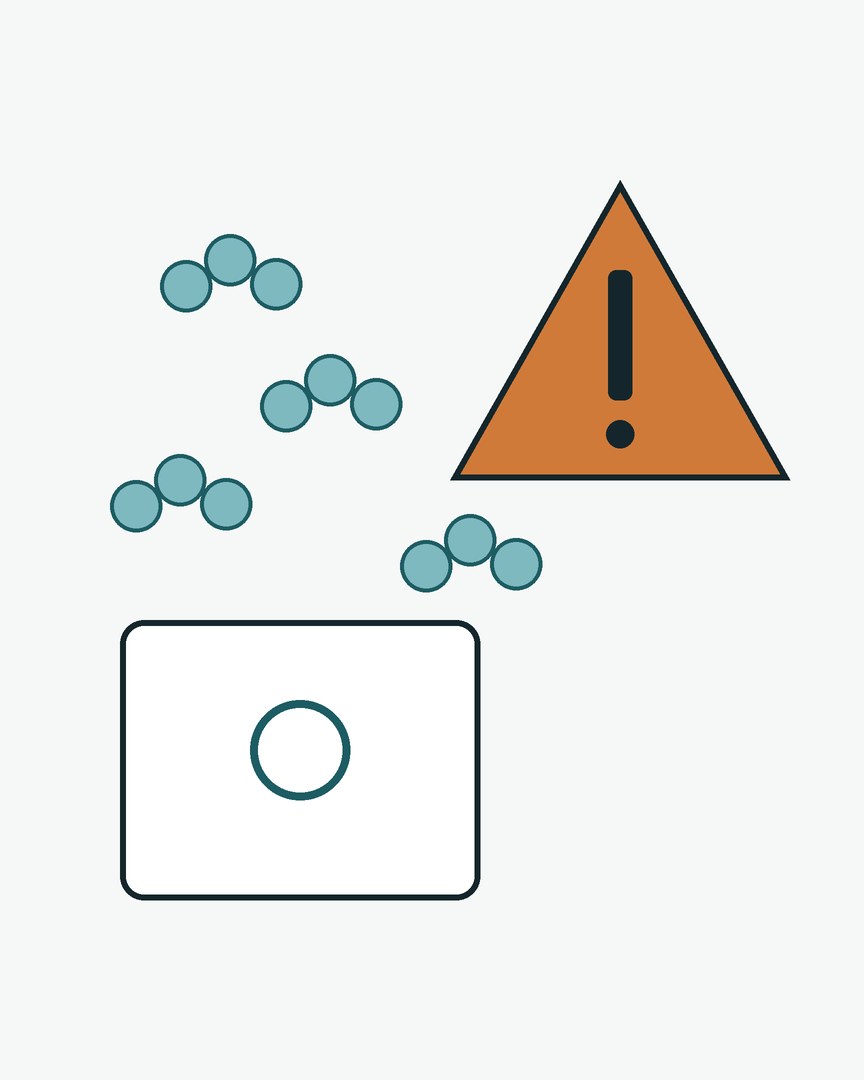
An electrostatic precipitator is an air cleaner that gives particles an electric charge and collects them on oppositely charged plates rather than in a filter. The same principle is used at industrial scale on smokestacks, and the home version is sold as an electrostatic or electronic air cleaner, as a portable box or a unit built into ductwork. EPA’s Technical Summary describes three trade-offs for a household: capture falls as the plates get dirty, gases and odors pass straight through, and the high voltage may produce ozone. Each of those is set out below, along with how the result compares with a filter.
How the plates collect particles
EPA’s description: “ESPs use a high-voltage wire to charge incoming particles, which are then collected onto oppositely charged plates inside the air cleaner.” CARB’s fact sheet says the units “use electrically charged plates to collect charged particles from air pulled through the device.”
So the sequence has two stages. A wire charges the particles in the air stream. The plates, carrying the opposite charge, pull those particles out and hold them. Unlike an ionizer, which lets charged particles settle on the room, a precipitator keeps what it catches inside the machine until the plates are cleaned.
Air passes between the plates rather than through a mat of fibers, and how fast it passes matters to the result.
How well it captures particles
EPA reports that ESPs “remove and collect small airborne particles and often have an initial single-pass removal efficiency of 60 percent or more for most particle sizes, increasing to as much as 95 percent depending on the airflow rate (the lower the airflow rate, the greater the removal efficiency).”
Read that sentence for what it says and what it leaves out. It is a single-pass figure, and it describes clean plates. It does not say how much pollution a room’s occupants ended up breathing, and it makes no claim about symptoms. The same technology at a lower fan speed captures a larger share of each pass but moves less air. Clean air delivery rate, or CADR, combines efficiency and airflow in one number for an actual machine, which is why a published CADR is more useful than a percentage on a box.
Dirty plates and the upkeep
The catch is in EPA’s next sentence: “This efficiency will be highest for clean ESPs, but their efficiency decreases as the collecting plates become loaded with particles.” Table 1 of the same document summarizes the entry for these devices as “Efficiency typically decreases with loading and plates require cleaning.”
Loaded plates do not necessarily change how the machine sounds, so it can seem normal while capturing less. EPA’s summary gives no cleaning interval, and none is offered here, because the right interval depends on the unit and on how much is in the air.
Practical handling, from the nature of the device:
- Switch the unit off and unplug it before opening it, and let the manual govern any further steps.
- Remove the collector cell as the manual describes, and clean it by the method the manual specifies.
- Let it dry fully before reinstalling, unless the manual says otherwise.
- Put a reminder on a calendar. A plate you never see is easy to forget.
Ozone: the question to settle first
EPA says “because ESPs and ionizers use high voltage to generate ionized fields, they may produce ozone, either as a byproduct or by design,” and that “Some makes and models of ESPs and ionizers can increase indoor ozone concentrations that can even exceed public health standards.” CARB’s fact sheet agrees on the spread: these technologies “typically produce only very low amounts of ozone, but some produce sufficient amounts of ozone to cause unhealthy exposures.”
EPA also warns that low output is not a complete answer: “even at concentrations below public health standards, ozone reacts with chemicals emitted by common indoor sources,” including household cleaning products, air fresheners and some flooring. Byproducts, by its account, may include ultrafine particles, formaldehyde, other aldehydes, ketones, peroxides and organic acids.
CARB’s list groups these machines in its “Electronic” category. It describes that category as devices that “may be capable of generating ozone, but have been tested and found to produce an ozone emission concentration no greater than 0.050 parts per million (50 ppb),” and it names electrostatic precipitators among them. CARB’s FAQ says all portable electronic air cleaners “must be tested to meet electrical safety and ozone, by the UL867 standard.” What that certification does and does not establish is a narrower thing than most listings suggest: CARB says it “does not reflect air cleaner effectiveness or ‘health safety’.”
What it does not remove
EPA is direct: “Although ESPs and ionizers remove small particles (including ultrafine particles), they do not remove gases or odors.” A precipitator sold for cooking fumes or for chemical odors is being sold for something the plates do not do. Removing gases takes an adsorbent such as activated carbon. EPA adds that there are no widely used performance ratings for portable air cleaners designed to remove gases, so the claim is hard to verify either way.
Electrostatic precipitator or filter
| Point of comparison | Electrostatic precipitator | Fibrous filter (HEPA-type or pleated) |
|---|---|---|
| How it captures | Charged plates inside the unit | Fibers in the air path |
| Over time | EPA: efficiency decreases as plates load | EPA: excessive loading reduces airflow; follow the maker’s replacement schedule |
| Upkeep | Plates must be cleaned | Filter must be replaced |
| Ozone | EPA: may produce it | CARB lists mechanical units as ones that “do not generate ozone or ions” |
| Gases and odors | EPA: not removed | Not removed unless the unit has a suitable adsorbent |
The honest comparison with HEPA needs one caution in each direction. EPA says that HEPA-designated home filters “usually perform at high levels comparable to a MERV 16,” but also that “there is no widely accepted definition of HEPA performance in consumer products,” so a label alone does not promise the 99.97 percent at 0.3 microns of the formal definition. The page on HEPA filters goes through what that number means. And on the precipitator side, the headline efficiency applies to clean plates at modest airflow.
For a household that wants a low-maintenance way to remove particles, the filter is the simpler bet: its capture does not depend on someone remembering to wash a collector, and a filter-only unit adds no ozone question. A precipitator can make sense for someone who prefers cleaning to replacing, provided the exact model has been checked on the California list and the upkeep actually happens.
Questions to answer before buying one
- Is the exact model on CARB’s list, and in which category? A listing settles the tested ozone limit and electrical safety, and nothing about cleaning.
- Does the maker publish a CADR for this model? Without one, a percentage cannot be turned into an amount of clean air for a room.
- What does the manual say about cleaning the collector, and can you realistically do that as often as it asks?
- Do you need gases or odors handled? If so, the plates will not do that, and the unit would need an adsorbent stage.
How the home unit relates to industrial precipitators
The term is also used for power plants and flue gas systems, where precipitators are large, purpose-built installations. The physics is shared with a countertop unit but the conditions are not: an industrial installation is engineered and maintained by operators for a specific gas stream, and its performance figures say nothing about a small appliance in a living room. Treat any number borrowed from industrial use as irrelevant to a home purchase.
You may not need any air cleaner: EPA’s advice on its ozone-generator page starts with “eliminating or controlling pollutant sources” and “increasing outdoor air ventilation.” Nothing here is medical advice, and a precipitator, like any air cleaner, cleans air only. CARB’s fact sheet notes that “The health benefits of air cleaning devices are not firmly established.” Anyone with a condition who is weighing an air cleaner should bring the question to a clinician.
Common questions
Do electrostatic precipitators produce ozone?
They can. EPA says they use high voltage and may produce ozone, either as a byproduct or by design, while CARB says these technologies typically produce only very low amounts but that some produce enough to cause unhealthy exposures. The practical step is to look the exact model up on CARB's list of certified devices.
How often should I clean electrostatic air cleaner plates?
Follow the manual for your model, because no agency text sets a single interval. Your own use decides it: EPA says efficiency falls as the plates load, so a home with more smoke, dust or pets will load them sooner. Switch the unit off and unplug it first, since these machines run on high voltage.
Is an electrostatic filter the same as an electrostatic precipitator?
No, despite the similar names. An electrostatic precipitator is a powered device with a charged wire and collecting plates. A filter described as electrostatic is usually a fibrous filter whose fibers hold a charge, with air pushed through it like any other filter. Read the listing carefully, because both words are used loosely.
Is an electronic air cleaner better than a HEPA filter?
EPA gives the two different profiles. An electrostatic precipitator's efficiency starts at 60 percent or more for most particle sizes on a single pass and can reach as much as 95 percent at lower airflow, while EPA says filters sold as HEPA are generally equivalent to MERV 16. CADR is the fair way to compare two actual machines, since it reflects both efficiency and airflow.
Sources
- U.S. EPA: Residential Air Cleaners, A Technical Summary, 3rd Edition
- California Air Resources Board: Air Cleaning Devices for the Home
- California Air Resources Board: List of CARB-Certified Air Cleaning Devices
- California Air Resources Board: Complying with the Air Cleaner Regulation, Frequently Asked Questions
- U.S. EPA: Guide to Air Cleaners in the Home, 2nd Edition
Read next
Ozone generators sold as air cleaners: why to avoid them
An ozone generator makes a lung irritant on purpose. What EPA, California, FDA and OSHA say, the levels measured in homes, and what to do if you own one.
CARB-certified air purifiers: what the label means
CARB certified air purifiers passed electrical safety and, if electronic, an ozone test, limit 0.050 ppm. What the label covers, what it omits, how to use the list.
MERV ratings: what the numbers mean for a home
A MERV rating reports how well an HVAC filter captures particles from 0.3 to 10 microns. EPA's chart, MERV 13, MERV vs HEPA and what your furnace can handle.
HEPA filters: what the term means and what it does not
A HEPA filter is defined by 99.97% capture at 0.3 microns, yet EPA says consumer HEPA has no widely accepted definition. What the label can tell you.
How do air purifiers work? Fan, filter and repeated passes
How do air purifiers work? A fan pulls room air through a filter and returns it, again and again. What each method removes, and what an air purifier cannot do.